Enabling Radical Innovations in Aviation
Potential areas of improvement in existing aircraft design methodologies and the means to address the gaps through a Novelty-focused Aircraft Design Framework (NOVAC)
The aviation industry is committed to curbing its aircraft emissions with ambitious targets, but radical innovations beyond incremental improvements of aircraft and engine efficiency and the use of alternative fuels are needed to achieve these targets. However, it is asserted that radical innovations are no longer readily encouraged in aircraft design and developments within the aviation industry. Specifically, aircraft development methodologies, while having matured significantly within the industry, are focused on supporting incremental innovations and therefore deemed to be weak in creativity and inventiveness. This article aims to present substantiations to this assertion by describing the state of modern aircraft design methodologies, the areas that could be improved to facilitate radical innovations, and a Novelty-focused Aircraft Design Framework (NOVAC) which is aimed at addressing the identified areas of improvement.
Dr. Leo Jeoh
Introduction
Several studies indicate that curbing aircraft emissions to meet sustainability targets will require radical innovations to aircraft and aviation technology (Ansell and Haran, 2020; Trancossi et al., 2014; Deisenroth and Ohadi, 2019; Isikveren and Schmidt, 2014; Clean Sky 2, 2021; Air Transport Action Group, 2010). However, at least three circumstances have led the modern aviation industry to favor and focus on incremental over radical innovations: a natural evolution of product development in industries, external socio-economic factors, and evolving public perceptions.
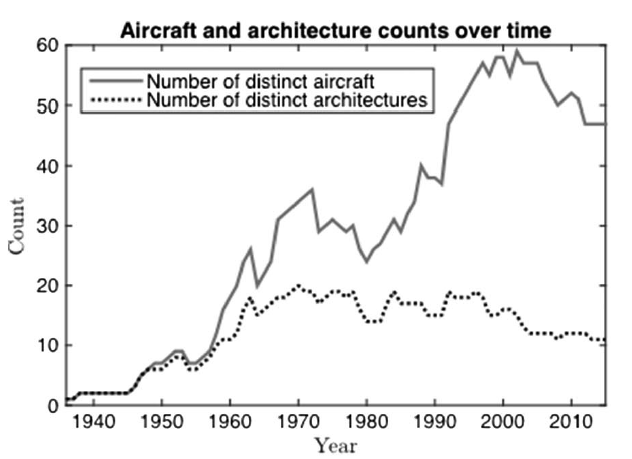
First, according to Utterback (Utterback, 1994), most industries are expected to follow a pattern of an initial period of multitudes of experiments and major product innovations that eventually give way to a phase where such activities dwindle, and product innovations become mostly small, incremental steps. The aviation industry is seemingly in such a phase. As shown in Figure 1, the number of unique aircraft designs and architectures is decreasing after a phase of growth during a formative period from the 1930s to the 1990s, and aircraft innovations now revolve around a dominant design (Murman, Walton, and Rebentisch, 2016).
Secondly, incremental innovations have become more favorable due to external socio-economic factors that have impacted the industry’s strategic goals. It can be said that the industry pursued radical innovations to fly faster, higher, and further as their key goal up to the 1990s, but global cost competition in commercial and military markets and reduced government investment in aerospace research, development, and technology with the end of the Cold War have led the industry to reduce its major innovation activities and instead focus its resources on improving cost, volume, and speed of production in an era of “Better, Faster, Cheaper” (Murman, Walton, and Rebentisch, 2016; Young, 2007). Achieving better, faster, and cheaper favors a strategy of implementing incremental innovations to a mature aircraft design architecture.
Finally, radical innovations could be said to be discouraged due to increased internal and public perception of aviation safety risks and the association of radical innovations with high risks of failure (Tatikonda and Rosenthal 2000), safety risks, and financial losses. Incremental innovations are perceived as being low-risk initiatives with a more immediate reward (McDermott and O’Connor, 2002), and therefore a more commonly favored practice.
Against the background of these circumstances, it is asserted that aircraft design methodologies have matured and become very well structured and developed in generating incremental innovations but remain weak in creativity and inventiveness (Jeoh, 2024). This article aims to support this assertion by describing the state of existing aircraft design methodologies, highlighting areas where improvements could be made to better enable radical innovations, and a design methodology to potentially address the identified areas of improvement.
Existing aircraft design methodologies
Modern aircraft are complex products that can be comprised of hundreds of cross-interacting sub-systems (Becz et al., 2010), with each sub-system being an individually complex system (Mowery and Rosenberg, 1981). Adding to the complexity, an aircraft operates in an overarching system-of-systems, influenced by multiple stakeholders and external political, economic, sociological, legal, technological, and environmental scenario factors (Kroll, 2012). To cope with the complexity, the process of developing aviation products has evolved from early methods of trial and error (Keane and Nair, 2005b) to practices of embodying systematic design approaches (Sadraey and Bertozzi, 2015; Cohen, Shaheen, and Farrar, 2021).
The common systematic design approach in modern aircraft development involves a form of Systems Engineering (SE). SE is a systematic framework that can be used in design to address customer requirements management, life-cycle management, and project management (Price, Raghunathan, and Curran 2006; Finkelstein and Finkelstein, 1983; Alderson et al., 1997). Several different SE process models have been developed throughout the history of SE, and the more common process models in practice include the Waterfall model by Royce (Royce, 1987), the Spiral model by Boehm (Boehm, 1988), and the Vee-Model (V-model) by Forsberg and Mooz (Forsberg and Mooz, 2014). Past aircraft designs have mostly adopted the Waterfall model, most likely due to the hardware-based nature of aircraft development (Jeoh, 2024). The waterfall model is mainly a single-pass approach that aims to have very clear definitions before moving onto the next stage of development to limit design changes late in the project. This is more favorable in hardware-based projects where it is highly desired to have as little design iteration as possible since remaking or modifying hardware can be uneconomical in the development process (Maier and Rechtin, 2000). V-model approaches are variants of a waterfall model process used in more recent aircraft developments where multiple subsystems are developed concurrently. The use of concurrent development could enable a more effective utilization of engineering resources; however, concurrent engineering can be more complicated to manage, and the gains in resource efficiencies are usually only apparent in projects that involve longer durations and a design that is very clearly defined. Both the waterfall model and the V-model can be said to be less effective in the development of radical innovations where design definitions and requirements could often change as knowledge and experience is gained in the novel technologies employed.
Concept Design is a stage within a SE process that comes after requirements management and before preliminary design. The innovativeness of a product is dependent on how ideas are generated within the Concept Design stage (Terwiesch and Ulrich, 2009), but Ideation is a step that is typically preceded and influenced by a feasibility study. A typical feasibility study assesses the likelihood that the requirements can be met with the available technologies and resources and determines whether Ideation should focus on adaptations or special versions of an existing aircraft, major modifications to an existing aircraft, or a completely new design (Howe, 2000). In existing aircraft design processes, the most cost-effective, lowest-risk, and certain approach to meet the project requirements is usually adopted, which typically results in radical innovations being excluded since revolutionary concepts may be assessed to be too imaginary and unrealistic (Sadraey, 2012), with too much uncertainty.
It is not surprising, therefore, to find that much of the development in ideation methods and tools has focused on making the ideation of adaptations or modifications to existing aircraft easier. These methods and tools for ideation aim to support the more common process of designing aircraft based on conventional configurations using empirical methods at the highest level, supplemented by sophisticated multidisciplinary simulations at more detailed levels (Price, Raghunathan, and Curran, 2006). For example, if designing an aircraft within an existing aircraft category, heuristic methods based on semi-empirical equations can be found in references such as those by Roskam (Roskam, 2003) and Raymer (Raymer, 1992). Additionally, aircraft design and manufacturing companies have also developed design philosophies for specific types of aircraft based on their many years of designing such aircraft. Boeing has design philosophies for structural design (Mohaghegh, 2005), and Airbus has knowledge-based engineering templates which guide the design process of subsystems such as wings (Struber, 2014). Following the high-level conceptualization, sophisticated tools and software have been developed to support the detailed development of concepts that are within known categories. Examples include the General Aviation Synthesis Program by NASA (NASA, 1978), the Advanced Aircraft Analysis Code (Roskam, Malaek, and Anemaat, 1990), the Flight Optimization System (Desch, 1995), or more recent open-source codes such as pyACDT (Perez and Martins, 2008). These help in defining aspects such as preliminary sizing, geometry, aerodynamics, mission, stability and control, aerodynamics, propulsion systems, and weight; however, they only apply if designing adaptations or modifications to existing aircraft types.
In novel aircraft design ideation, brainstorming is seemingly the most common and arguably only method used (Sadraey, 2012; Kazula and Hoschler, 2019; Altshuller, 1984). In brainstorming, ideas are seemingly mostly inspired by historic aircraft design research and concepts as opposed to original ideas from scratch (Jeoh, 2024). For example, X2 and X3 compound rotorcraft (Ormiston, 2016) and blended-wing body airplane concepts (Okonkwo and Smith, 2016) can be said to have been inspired by historic concepts ideated many decades ago that were not successful and pursued further at the time. This practice of drawing from past knowledge may be favored as engineers are usually more comfortable with the analytical nature of modifying and adapting from an existing design as opposed to creative design synthesis from scratch (Crisler and Brandt, 1998). There are reports within the industry of applications of alternative methods for ideation, such as TRIZ by Altshuller (Altshuller, 1999), but such methods have not yet been systematically applied and typically only on components (Platt, 2020; Molina Navas, and Nunes, 2014; Cavallucci, Fuhlhaber, and Riwan, 2015). Literature reviews suggests that, apart from brainstorming, there are no systematic ideation methods or tools adopted in the aviation industry to generate novel aircraft ideas from scratch (Jeoh, 2024).
Needs in existing aircraft design methodologies to enable more radical innovations
Based on a paradigm that technology development involves three stages of invention, innovation, and diffusion (Jaffe, Newell, and Stavins 2002) and the state of existing aircraft design methodology, the aviation industry could be said to be weak at invention (generating novel concepts). Specifically, there are potential gaps within the concept design stage in methods to assess and manage uncertainties associated with radically new concepts and methods to systematically generate novelty in concepts (Jeoh, 2024). Uncertainty precludes engineers from being able to form and consider novel concepts within the concept design stage, and a systematic methodology for ideation would enhance the formation of novel concepts.
Managing Uncertainty
Uncertainty in the aviation industry during concept design could come from two sources: technological uncertainty and certification uncertainty. Technological uncertainty in aircraft design can be defined as “a perceived inability to accurately predict the effects of using a technology on an aircraft design due to insufficient information or understanding of the technology and resultant aircraft design” (Jeoh, 2024). As a start, architectural innovation is a technique that can generate radical innovations using or combining existing and mature technologies in new ways and design architectures and could be leveraged. While technological uncertainty would not be eliminated (the resultant concept is radically novel), it is expected to be significantly reduced by using existing mature technologies. Alternatively, technological uncertainty could be reduced through iterative testing and learning, and therefore such a learning approach should be incorporated into the Concept Design stage. The need to ascertain and reduce technological uncertainty implies a need for the means to evaluate a technology’s level of uncertainty and a criterion to determine when technologies are suitably mature for use in novel concepts.
Certification uncertainty is the level of uncertainty generated over the effort, duration, and cost of projects with novel concepts or technologies to meet existing airworthiness certification expectations. The existing certification paradigm is arguably not compatible with radical innovations, as the novel technologies employed may not be sufficiently understood to prescribe safety requirements or accurately determine failure modes and probabilities. There can therefore be uncertainty that stems from the inability to assess a radical innovation’s potential level of compliance with certification requirements. Without an ability to evaluate the level of certification uncertainty, novel concepts could be generally excluded from concept generation.
Evaluating the level of uncertainty would need to consider that certification is aimed at assuring both the compatibility of a design with the existing ecosystem and safety. For the first type of requirements, cases from transportation technology adoption suggest that the ecosystem will adapt to novel developments that are perceived to have sufficient potential economic benefit and social utility. For example, changes to air traffic management systems, airport operations, and regulations are ongoing to capture the benefit of drones and electric vertical take-off and landing vehicles (European Commission, 2022). Electric road vehicles are another example where adaptations in land transportation standards and the introduction of new infrastructure, such as charging stations, were instituted due to perceived economic and social utility potential (Das et al., 2020). Socio-economic benefit potential may therefore be a potential alternative metric to assess the potential compliance of novel concepts to certification requirements in this regard.
In safety assurance, an alternative and arguably more appropriate method of evaluation for novel concepts, as opposed to determining and demonstrating failure modes and probabilities, is to focus on determining potential hazards and the ability to control these hazards. The legacy concept of safety assumes that the safety of a system is directly associated with its individual subsystem reliabilities, but safety and reliability are very different properties (Leveson, 2016). Hazards are not failures, as failures can occur without resulting in a hazard, or a hazard may occur without precipitating any failures (Leveson, 2012c). Furthermore, there can be safe systems with unreliable sub-systems if the system is designed and operated so that the subsystem failures do not create hazardous system states (Leveson, 2012b). Ultimately, reliability is a subsystem property, while safety is an emergent property of a system (Leveson, 2012d). Hence, arguably, safety assurance should be more about assessing hazard potential and the means to mitigate the hazards, which can be readily conducted even in novel concepts. Certification uncertainty in terms of safety assurance may therefore be assessed through a means that involves identifying hazards, hazard controls, and hazard mitigation impacts, and the designated metric of uncertainty could relate to a level of confidence in implementing the identified hazard controls.
Systematic methodology for ideation
The general aircraft design methodology is well structured and mature, and it has been identified that enabling engineers to generate more novel aircraft design concepts may involve modifying the concept design stage of the methodology. A systematic methodology for ideation would then involve incorporating elements supporting uncertainty management (technological and certification) and creative ideation.
For creative ideation, a key goal would be to provide designers with access to a wider knowledge of external technologies during ideation. Having access to a wider knowledge of external technologies (technologies used outside the industry) and methods to aid in the retrieval and association of novel technologies may support the production of a greater variety and number of novel concepts (Jeoh, 2024). It is suggested that creative ideation of novel aircraft concepts can be better facilitated with a knowledge repository containing explicit design knowledge from outside the aviation industry. Design knowledge is knowledge related to practices, solutions, and knowledge of artifacts (as opposed to scientific knowledge focused on the knowledge of natural phenomena), and explicit knowledge are formalized elements of information represented through media that can be communicated and shared, such as documents, catalogs, drawings, and databases (Senker, 1995; Nonaka, 2007). The benefits of a curated design knowledge repository also apply to architectural innovation; however, it is noted that it may be more effective to clearly distinguish the exercise of architectural innovation from ideating from scratch and separating the knowledge repository for architectural innovations to preclude within-industry knowledge from biasing the ideation activity due to familiarity (Jeoh, 2024).
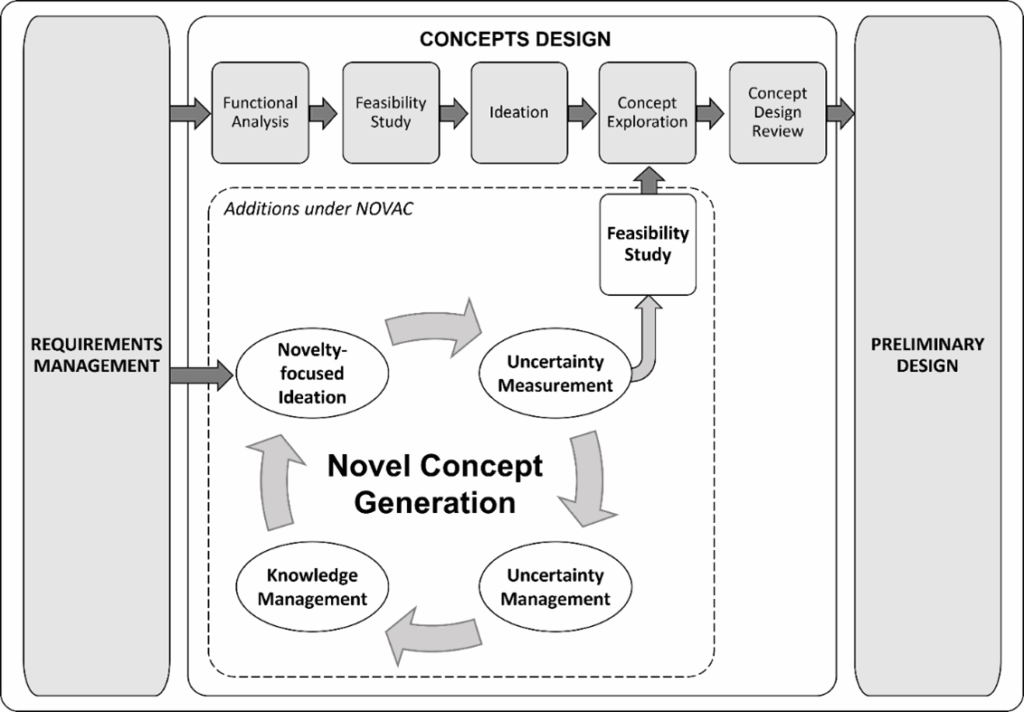
The Novelty-focused Aircraft Concept Design Framework (NOVAC) (Jeoh, 2024) is a design framework aimed at enabling engineers in the aviation industry to generate more novel aircraft concepts by addressing the areas for improvement as discussed above. NOVAC recognizes that there is no need to replace the existing aircraft design methodology and proposes to append the existing methodology with a parallel Novel Concept Generation path between requirements management and concept exploration, as shown in Figure 2. The secondary concept generation path is focused on generating and maturing novel ideas into concepts before considering feasibility, thereby also enabling unique methods for creative ideation to be incorporated into the overall concept design process flow.
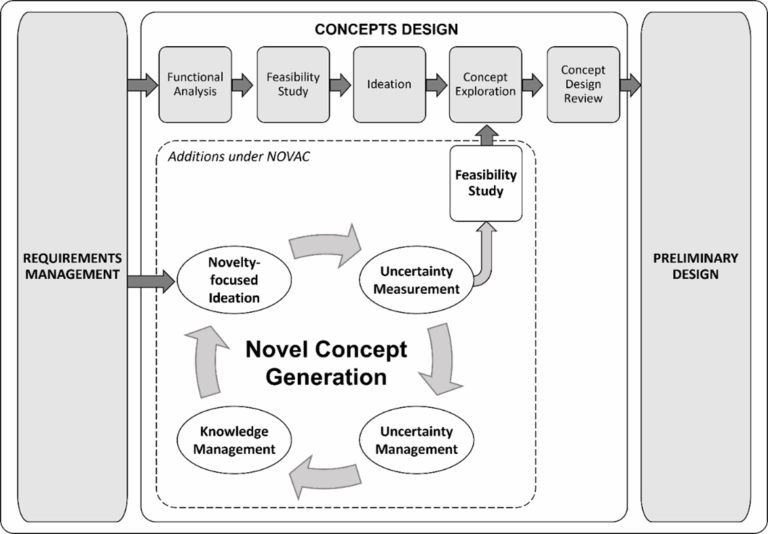
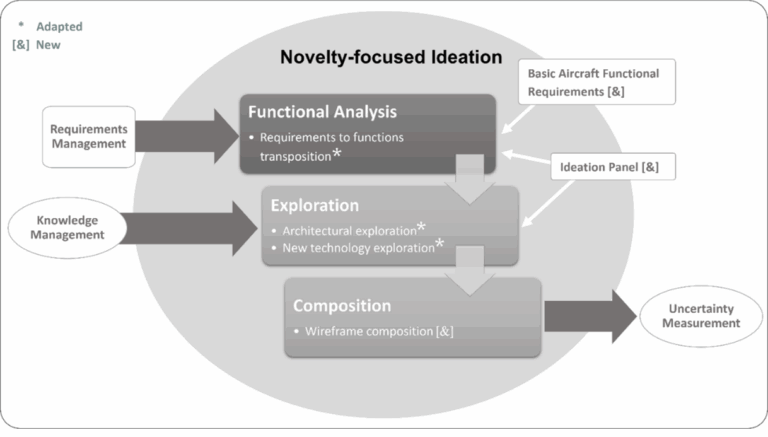
The novel concept generation process is an iterative concept generation path that aims to structure the discovery of novel aircraft design ideas and the development of these ideas into concepts as supplementary design options for concept exploration. The process would typically start at Novelty-focused Ideation, where a guided process for ideation using functional analysis, idea exploration, and concept composition methods supported by curated technological knowledge sources for inspiration is proposed under NOVAC, as shown in Figure 3. This process incorporates two key principles– generating concepts using functional requirements and suspending judgment of feasibility. Additionally, it systematically ensures that creative ideation is explored through the methods of architectural innovation (architectural exploration) as well as methods for new technology exploration.
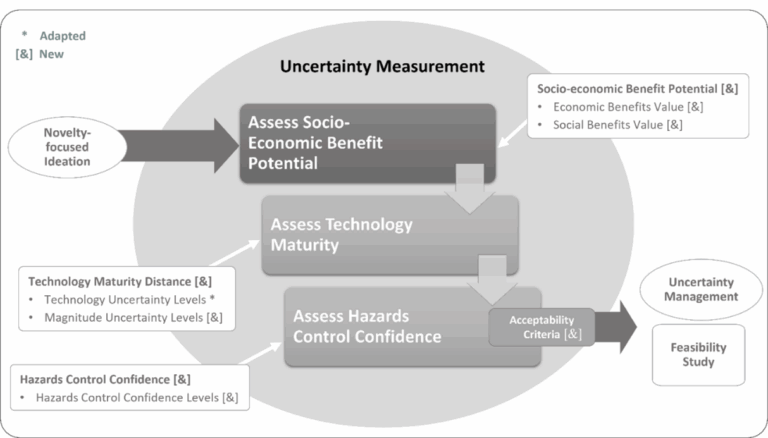
Uncertainty measurement involves a means of evaluating novel concepts based on the principle of confidence levels– the levels of confidence that a concept would comply with design and airworthiness requirements when realized into a product. The confidence level is evaluated using socio-economic benefit potential, technological maturity, and hazard control confidence metrics, and NOVAC proposes a detailed means of calculating these metrics and the associated novel concept acceptance criteria. The process flow in uncertainty measurement is shown in Figure 4.
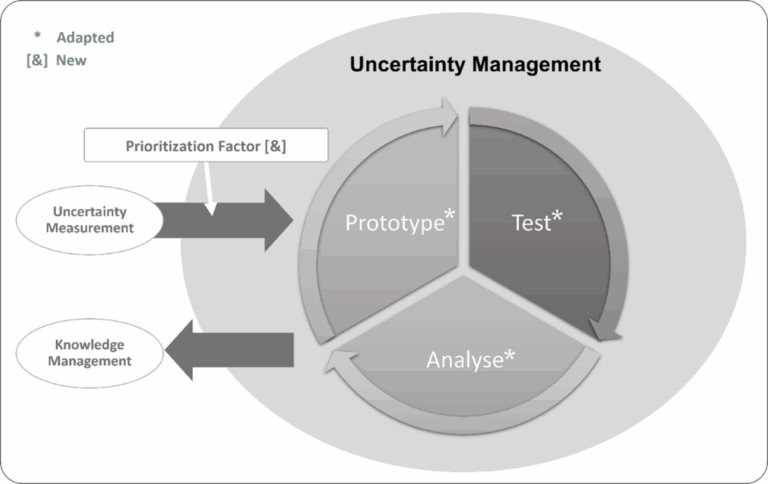
Uncertainty management, as shown in Figure 5, is a step involving the iterative prototyping, testing, and analysis to improve knowledge of technologies used in a concept that has not passed the acceptability criteria during uncertainty measurement. The aim in this stage is to test and learn to gain a better understanding of socio-economic benefit potentials, potential hazards, or to advance technology maturity.
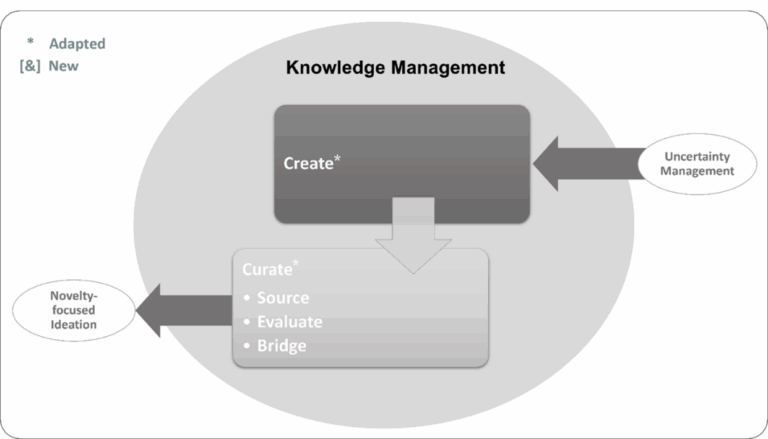
Finally, the novel concept generation cycle is supported with knowledge management, which is a means to capture and present the learnings from uncertainty management and prepare materials that could serve as inspiration for novel ideas during the novelty-focused ideation step, as shown in Figure 6. Knowledge management can involve both the creation and curation of explicit design knowledge in such a way as to facilitate search and use during ideation.
NOVAC was developed to address the proposed needs to improve the aircraft design process in encouraging radical innovations. While some parts of NOVAC are not new individually, NOVAC integrates and sequences these methods and tools in a unique approach. Uncertainty measurement is almost entirely unique to NOVAC except for how technological uncertainty is measured, which is adapted from an existing means of measuring technological uncertainty.
The effectiveness of NOVAC has been evaluated through a correlational study involving teams of practicing aeronautical engineers exercising a design task with and without the NOVAC approach (Jeoh, 2024). In this study, the Novelty-focused Ideation method was found to be potentially useful in generating more aircraft concepts. Results on concept variety were limited due to a small sample size but indicated a possible positive effect through NOVAC’s proposed Novelty-focused ideation process. The study also made observations supporting the need for Knowledge Management for more novel concept generation, while the impact of Uncertainty Measurement and Management on facilitating radical innovations has yet to be evaluated.
Overall, the evaluation of NOVAC provided empirical data to support that a methodology with the specific aim of generating novel concepts is required in the aviation industry for radical innovations; otherwise, aeronautical engineers have a tendency towards traditional brainstorming methods and the generation of incremental improvements to existing aircraft designs. Developing and testing NOVAC provided a positive indication that it may be possible to encourage radical innovations through design supports that modifies the existing aircraft design methodology innovations and addresses the potential gaps described in this article.
Areas for further study
The research has yet to consider organizational factors, and further work could be done to determine how enhancing the existing aircraft design methodology could impact considerations such as organizational structure and resource allocations. For example, novel concept generation, being a unique development path, opens the possibility for firms to have team(s) or a department specifically focused on the practice of novel concept generation. Furthermore, uncertainty measurement management could better facilitate purposeful experimentation and thereby allow for the optimization of a company’s resources (Murray and Trispas, 2004).
Systematic methodologies for aircraft design that address novel concept generation also present an opportunity to study the application of digital process automation and artificial intelligence for either parts or the entire process to explore concepts continuously and rapidly as design knowledge evolves. While novelty-focused ideation and uncertainty management may be difficult to complete without human intervention, other elements and principles addressing the gaps identified may be able to benefit from digital process automation and artificial intelligence.
Finally, the aircraft design process is predominantly a generic SE practice during the early stages, such as Concept Design, and therefore not unique to the aviation industry (Sadraey, 2012). On that note, there could be the potential to generalize or adapt the considerations and methodology described in this article for industries like the aviation industry, where products are complex, safety and reliability are paramount, and there is a high level of regulation.
References
- Air Transport Action Group (Nov. 2010). Beginner’s Guide to Aviation Efficiency. Report. Air Transport Action Group.
- Alderson, A. et al. (1997). An improved system engineering model. Conference Paper. DOI: 10.1109/ecbs.1997.581925.
- Altshuller, G.S. (1984). Creativity As an Exact Science. 1st. CRC Press. ISBN: 9780429073793. DOI: 10.1201/9781466593442.
- — (1999). The Innovation Algorithm: TRIZ, Systematic Innovation and Technical Creativity. ISBN: 9780964074040.
- Ansell, Phillip J. and Kiruba S. Haran (2020). “Electrified Airplanes: A Path to Zero- Emission Air Travel”. In: IEEE Electrification Magazine 8.2, pp. 18–26. ISSN: 2325-58972325-5889. DOI: 10.1109/mele.2020.2985482.
- Becz, Sandor et al. (2010). Design System for Managing Complexity in Aerospace Systems. Conference Paper. DOI: 10.2514/6.2010-9223.
- Boehm, B. W. (1988). “A spiral model of software development and enhancement”. In: Computer 21.5, pp. 61–72. ISSN: 0018-9162. DOI: 10.1109/2.59.
- Cavallucci, D., Simon Fuhlhaber, and A. Riwan (2015). “Assisting Decisions in Inventive Design of Complex Engineering Systems”. In: Procedia Engineering 131, pp. 975–983. ISSN: 18777058. DOI: 10.1016/j.proeng.2015.12.409.
- Clean Sky 2 (Oct. 2021). Clean Sky 2 Joint Undertaking Development Plan. Report. European Union / Clean Sky 2.
- Cohen, Adam P., Susan A. Shaheen, and Emily M. Farrar (2021). “Urban Air Mobility: History, Ecosystem, Market Potential, and Challenges”. In: IEEE Transactions on Intelligent Transportation Systems 22.9, pp. 6074–6087. ISSN: 1524-9050 1558-0016. DOI: 10.1109/tits.2021.3082767.
- Crisler, William P. and Steven A. Brandt (1998). “Teaching the Nine Technologies of Conceptual Aircraft Design”. In: SAE Technical Paper Series, p. 11. ISSN: 0148-7191. DOI: 10.4271/985531.
- Das, H. S. et al. (2020). “Electric vehicles standards, charging infrastructure, and impact on grid integration: A technological review.” In: Renewable and Sustainable Energy Reviews 120. ISSN: 13640321. DOI: 10.1016/j.rser.2019.109618.
- Deisenroth, David C. and Michael Ohadi (2019). “Thermal Management of High-Power Density Electric Motors for Electrification of Aviation and Beyond”. In: Energies 12.19. ISSN: 1996-1073. DOI: 10.3390/en12193594.
- Desch, Jeremy D. (1995). The Development and Use of a Flight Optimization System Model of a C-130E Transport Aircraft. Report. Aeronautics Program Group.
- European Commission (2022). Communication from the Commission to the European Parliament, The Council, The European Economic and Social Committee and the Committee of the Regions: A Drone Strategy 2.0 for a Smart and Sustainable Unmanned Aircraft Eco-System in Europe. Government Document.
- Finkelstein, L. and A. C. W. Finkelstein (1983). “Review of design methodology”. In: IEE Proceedings A Physical Science, Measurement and Instrumentation, Management and Education, Reviews 130.4. ISSN: 0143702X. DOI: 10.1049/ip-a-1.1983.0040.
- Forsberg, Kevin and Harold Mooz (2014). 4.4.4 Application of the ‘Vee’ to Incremental and Evolutionary Development. Conference Paper. DOI: 10.1002/j.2334-5837. 1995.tb01948.x.
- Howe, Denis (2000). Aircraft Conceptual Design Synthesis. John Wiley and Sons Ltd. ISBN: 9781860583018 9781118903094. DOI: 10.1002/9781118903094.
- Isikveren, Askin T. and Michael Schmidt (2014). Future Transport Aircraft Ultra-Low Emissions Technology Options. Conference Paper.
- Jaffe, Adam B., Richard G. Newell, and Robert N. Stavins (2002). “Environmental Policy and Technological Change”. In: Environmental and Resource Economics 22.1/2, pp. 41–70. ISSN: 09246460. DOI: 10.1023/a:1015519401088.
- Jeoh, Leo (2024). Novelty Focused Aircraft Concept Design Framework, PhD Thesis, Singapore University of Technology and Design, 18 March 2024.
- Kazula, Stefan and Klaus Hoschler (2019). “A systems engineering approach to variable intakes for civil aviation”. In: Proceedings of the Institution of Mechanical Engineers, Part G: Journal of Aerospace Engineering 234.10, pp. 1721–1729. ISSN: 0954-4100 2041-3025. DOI: 10.1177/0954410019836903.
- Keane, Andy J. and Prasanth B. Nair (2005a). Computational Approaches for Aerospace Design. John Wiley and Sons, Ltd. ISBN: 9780470855409 9780470855485. DOI: 10.1002/0470855487.
- Kellari, Demetrios, Edward F. Crawley, and Bruce G. Cameron (2018). “Architectural Decisions in Commercial Aircraft from the DC-3 to the 787”. In: Journal of Aircraft 55.2, pp. 792–804. ISSN: 0021-8669 1533-3868. DOI: 10.2514/1.C034130.
- Kroll, Ehud (2012). “Design theory and conceptual design: contrasting functional decomposition and morphology with parameter analysis”. In: Research in Engineering Design 24.2, pp. 165–183. ISSN: 0934-9839 1435-6066. DOI: 10.1007/s00163-012-0149-6.
- Leveson, Nancy (2012b). “Questioning the Foundations of Traditional Safety Engineering”. In: Engineering a Safer World. Chap. 2, pp. 7–60. ISBN: 9780262298247. DOI: 10.7551/mitpress/8179.003.0005.
- — (2012c). “Questioning the Foundations of Traditional Safety Engineering.” In: Engineering a Safer World. Chap. 7, pp. 7–60. ISBN: 9780262298247. DOI: 10.7551/mitpress/8179.003.0005.
- — (2012d). “Questioning the Foundations of Traditional Safety Engineering.” In: Engineering a Safer World. Chap. 3, pp. 7–60. ISBN: 9780262298247. DOI: 10.7551/mitpress/8179.003.0005.
- — (2016). “Engineering a Safer World: Systems Thinking Applied to Safety”. In: The MIT Press. Chap. 1, pp. 3–6. ISBN: 9780262298247. DOI: 10 . 7551/mitpress /8179.001.0001.
- Maier, Mark W. and Eberhardt Rechtin (2000). The Art of Systems Architecting. 2nd ed. CRC Press. ISBN: 9780429196140. DOI: 10.1201/9781420079142.
- McDermott, Christopher M. and Gina Colarelli O’Connor (2002). “Managing radical innovation: an overview of emergent strategy issues”. In: Journal of Product Innovation Management 19.6, pp. 424–438. ISSN: 07376782. DOI: 10.1111/1540-5885.1960424.
- Mohaghegh, Michael (2005). “Evolution of Structures Design Philosophy and Criteria.” In: Journal of Aircraft 42.4, pp. 814–831. ISSN: 0021-8669 1533-3868. DOI: 10.2514/1.11717.
- Molina, Joao D., Helena V. G. Navas, and Isabel L. Nunes (2014). “TRIZ Methodology Applied to Noise Comfort in Commercial Aircraft”. In: Proceedings of the Eighth International Conference on Management Science and Engineering Management. Advances in Intelligent Systems and Computing. Chap. Chapter 121, pp. 1409–1419. ISBN: 978-3-642-55121-5 978-3-642-55122-2. DOI: 10.1007/978-3-642-55122-2_121.
- Mowery, David C. and Nathan Rosenberg (1981). “Technical change in the commercial aircraft industry, 1925–1975”. In: Technological Forecasting and Social Change 20.4, pp. 347–358. ISSN: 00401625. DOI: 10.1016/0040-1625(81)90065-2.
- Murman, E. M., M. Walton, and E. Rebentisch (2016). “Challenges in the better, faster, cheaper era of aeronautical design, engineering and manufacturing”. In: The Aeronautical Journal 104.1040, pp. 481–489. ISSN: 0001-9240 2059-6464. DOI: 10.1017/s0001924000091983.
- Murray, Fiona and Mary Tripsas (2004). “The Exploratory Processes of Entrepreneurial Firms: The Role of Purposeful Experimentation”. In: Business Strategy over the Industry Lifecycle. Advances in Strategic Management, pp. 45–75. ISBN: 0-7623-1135-5. DOI: 10.1016/s0742-3322(04)21002-6.
- NASA (1978). GASP – General Aviation Synthesis Program. Government Document.
- Nonaka, Ikujiro (2007). “The Knowledge-Creating Company”. In: Harvard Business Review,pp. 162–171.
- Okonkwo, Paul and Howard Smith (2016). “Review of evolving trends in blended wing body aircraft design.” In: Progress in Aerospace Sciences 82, pp. 1–23. ISSN: 03760421.DOI: 10.1016/j.paerosci.2015.12.002.
- Ormiston, Robert A. (May 2016). “Realizing the Potential of the Compound Helicopter”.In: Vertiflite.
- Perez, Ruben and Joaquim R. R. A. Martins (2008). pyACDT: An Object-Oriented Framework for Aircraft Design Modelling and Multidisciplinary Optimization. Conference Paper. DOI: 10.2514/6.2008-5955.
- Platt, Richard (2020). Aviation Industry Case Studies Boeing GE Aviation BAE Systems Airbus. Report. Strategy Innovation Group. DOI: 10.13140/RG.2.2.29084.31360.
- Price, M., S. Raghunathan, and R. Curran (2006). “An integrated systems engineering approach to aircraft design”. In: Progress in Aerospace Sciences 42.4, pp. 331–376. ISSN:03760421. DOI: 10.1016/j.paerosci.2006.11.002.
- Raymer, Daniel P. (1992). Aircraft Design: A Conceptual Approach. 2nd ed. Washington, DC: American Institute of Aeronautics and Astronautics Inc. ISBN: 0930403517.
- Roskam, J. (2003). Airplane Design Part I: Preliminary Sizing of Airplanes. Lawrence, Kansas USA.: Design Analysis and Research Corporation. ISBN: 978-1884885426.
- Roskam, J., S M. Malaek, and W. Anemaat (1990). AAA (Advanced Aircraft Analysis): A User-friendly approach to preliminary aircraft design. Conference Paper.
- Royce, Winston W. (1987). “Managing the development of large software systems: concepts and techniques”. In: 9th international conference on Software Engineering, pp. 328–338. DOI: 10.5555/41765.41801.
- Sadraey, Mohammad H. (2012). Aircraft Design: A Systems Engineering Approach. UK: John Wiley and Sons Ltd. ISBN: 9781119953401 9781118352700. DOI: 10.1002/9781118352700.
- Sadraey, Mohammad H. and N. Bertozzi (2015). System Engineering Approach in Aircraft Design Education: Techniques and Challenges. Conference Paper. DOI: 10.18260/p.24790.
- Senker, Jacqueline (1995). “Tacit Knowledge and Models of Innovation”. In: Industrial and Corporate Change 4.2, pp. 425–447. ISSN: 0960-6491 1464-3650. DOI: 10.1093/icc/4.2.425.
- Struber, Henning (Sept. 2014). The Aerodynamic Design of the A350 XWB-900 High Lift System. Conference Paper.
- Tatikonda, M. V. and S. R. Rosenthal (2000). “Technology novelty, project complexity, and product development project execution success: a deeper look at task uncertainty in product innovation”. In: IEEE Transactions on Engineering Management 47.1,pp. 74–87. ISSN: 00189391. DOI: 10.1109/17.820727.
- Terwiesch, Christian and Karl Ulrich (2009). Innovation Tournaments: Creating, Selecting, and Developing Exceptional Opportunities. Harvard Business Press.
- Trancossi, Michele et al. (2014). Increasing Aeronautic Electric Propulsion Performances by Cogeneration and Heat Recovery. Conference Paper. DOI: 10.4271/2014-01-2106.
- Utterback, James M. and William J. Abernathy (1975). “A dynamic model of process and product innovation”. In: Omega 3.6, pp. 639–656. ISSN: 03050483. DOI:10 .1016/0305-0483(75)90068-7.
- Young, T. M. (2007). “Aircraft Design Innovation: Creating an Environment for Creativity.” In: Proceedings of the Institution of Mechanical Engineers, Part G: Journal of Aerospace Engineering 221.2, pp. 165–174. ISSN: 0954-4100 2041-3025. DOI: 10.1243/09544100jaero129.